Your Adventure, Your Way
Explore our curated itineraries designed to showcase the best of Tanzania — from epic safaris to cultural gems — all tailored to suit your pace and passion.
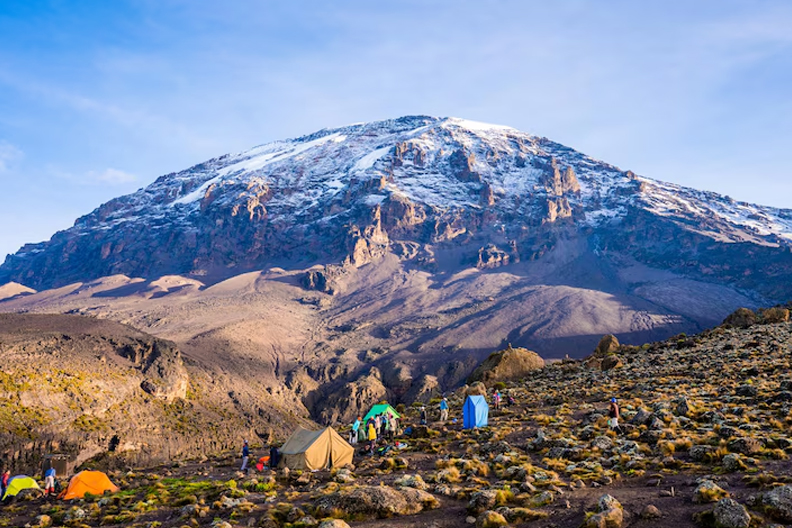
Non-summit treks on Kilimanjaro
These treks are ideal for those who do not have enough time to summit Africa’s highest peak, want to take their children along, or are unsure about the effects of high altitude.
We offer a 1-day trek on the Shira Plateau in the West or a 1-day trek on the Marangu route in the east. We supply a qualified guide who is Wilderness First Responder trained, lunch packs and water, and you can trek anywhere between 3 and 6 hours depending on fitness levels.
Kilimanjaro Shira Plateau Trek or Mountain Biking (full day)
This trek is for those who wish to experience Kilimanjaro without having to reach the summit. The Shira Plateau offers one of the best views of Kilimanjaro’s glaciered summit. It’s about 2 hours’ drive from Arusha to Londorossi Gate to complete entry formalities, then continue for another hour up to Morum Barrier Gate. Begin trekking or mountain biking through heather and moorland. Explore the Shira plateau and visit the ancient collapsed Shira cone, the oldest of Kilimanjaro’s three volcanoes. The amount of time for trekking depends on your energy levels and the time you reach the start point. We recommend a very early start for up to 5 hours hiking or staying closer to West Kilimanjaro for a more leisurely 2 to 3-hour hike. Lunch boxes are provided.
Kilimanjaro Marangu Day trek (full day)
On this hike, we explore the lower reaches of Kilimanjaro that early explorers first discovered. After formalities at the gate, you walk through dense and humid forests for up to 4 hours, and if you are lucky, you may spot the black and white Colobus monkeys in the trees. Continue until you reach the Mandara Huts at 2743m. After your picnic lunch – and if time permits – walk to the Maundi Crater for a long view over the plains and Lake Jipe, and in the distance, the Pare and Usambara mountains.
Descend to the gate to meet your driver and the drive back to your hotel.
What to bring on your trek
Good walking shoes or boots are necessary and we recommend walking poles and an extra layer of warm clothing as conditions can change rapidly. Good sun and rain protection is a must, and all guests should carry a daypack to keep drinking water and other necessities.


South Pare Mountains
The rural spread of the Southern Pare Mountains is also a magical, forested expanse of hidden villages, valleys and homesteads clinging to steep handmade terraces, with plenty to inspire an inquisitive mind. The tourism project here is located in high in the Mbaga Hills, in an area with an extraordinary local and colonial history. The traditional Pare culture is still much in evidence, and witch doctors from here are so renowned that people travel long distances, even urban dwellers from Arusha venture this far south to decipher unusual problems.
Areas such as Malameni Rock, where children were sacrificed to appease evil spirits until the 1930s, can now be climbed after receiving special instruction from the hut below. It is not far from here to the legendary Mghimbi Caves, which provided a natural hideaway and haven for local tribes during slave raids. Both of these can be visited on a half day walk. More spiritualism can be found among the tropical fruit trees and banana palms in Ikongwe Village, reached in a full day excursion from Mbaga, a beautiful and fruitful area that is believed to be a gift from the heavens, and where now a very distinct religious community has developed.
Another area considered with great respect by local communities is Mpepera Viewpoint atop Mpepera Hill, where a cross has been erected to represent the peace between the resident Catholic and Protestant communities. The viewpoint is used by locals as a peaceful area for prayers, and gives excellent views of Mount Kilimanjaro, or the Mbaga Hills and Mkomazi Game Reserve when the skies are clear. Full day walks can also be arranged into local villages to visit families practising traditional methods to brew quantities of beer or longer hikes through unspoiled woodland such as Shengena Forest. Here it is possible to camp under the stars and wake up for a sunrise hike up Shengena Peak, the highest point in the Pare and Usambara Mountains at 2,463m above sea level, and discover fresh springs and troops of colobus monkeys and enjoy magnificent views over Same and Lushoto.
History
The Pare are known to have had an extensive fortified capital, under their chief Ghendewa. He started and managed a conscript army and masterminded a unified tribe with a ‘sophisticated social system’. Ghendewa was killed fighting the Chagga. Reverend Jacob Jenson Dannholz missionary from Leipzig came to live in Mbaga for approximately 10 years between 1908 – 1917, and built a church and farmhouse on Tona Moorland. Locally known as The White Man’s House, but it is officially named ‘Dannholz Cottage’ in honor of the man who built it. This has been used by the missionaries ever since, and four bedrooms are available for visitors.


Usambara Mountains
Usambara is a beautiful mountain range with grassy plains and virgin tropical rainforest. The area has many colorful villages you can visit during your stay here. The Usambara mountains are located northeastern Tanzania, near Mkomazi National Park, about 3 hours’ drive (110 km) west of Tanga.
It is one of the undiscovered places in Tanzania. And this is what makes it a true paradise for nature and hiking lovers. The lush green mountains have a cool climate that is ideal for walks and hikes. But one of the best reasons to hike the Usambara Mountains is the amazing view. You’ll see sweeping hills, mountains, valleys, farmland, picturesque villages, colorful markets and plantations everywhere you go.
The Usambara Mountains comprise the easternmost ranges of the Eastern Arc Mountains. They are 90 km long and about half that wide. Faulting and uplifting formed them nearly two million years ago, and they are composed of Precambrian metamorphic rocks.
Birds in Usambara
Usambara Mountains are very unusual in East Africa with their natural regions still covered in tropical forests and therefore they are considered a tremendously significant ecologically and a biodiversity hotspot with many protected zones. Several species are living in the Usambara forests, including the Usambara eagle-owl, the Usambara akalat, the Usambara weaver and the African violet. You can also spot other bird like the Mountain buzzard, Crown eagle, Eastern bronze-naped pigeon, Lemon and Dusky turtle dove and the Hartlaub’s Turaco
Flora and Fauna found in the Usambara mountains
You can find over 3000 plant species and over 600 tree species that thrive in the Usambara Mountains. Therefore it is known as one of the world’s biodiversity hotspots. It’s here for attracts naturalists and nature lovers from all over the world who come to watch birds, study trees and flowers or butterflies. Several species are endemic to the Usambara forests.
Most common animals in Usambara Mountains
- Usambara eagle-owl
- African violet
- Usambara akalat and weaver
- Mountain buzzard
- Crown eagle
- Eastern bronze-naped pigeon
- Lemon and Dusky turtle dove
- Hartlaub’s Turaco
Hiking activities
You can go for a hike with a local guide and discover the beautiful diversity of this vast area. On a clear day you can see the grass plains of Mkomazi as well as Kilimanjaro and enjoy the beautiful views that this area has to offer. During this special walk you will have the opportunity to meet the locals who will wave to you and give you a friendly smile. The locals are very hospitable and if you are open and interested, you will be spontaneously invited to get to know them better.
You can hike up the Irente viewpoint to get a panoramic view of Mazinde village almost 1000 m below and the vast Maasai plains beyond.
Or walk through the fertile farmlands of Jaegertal to a fruit tree nursery and learn more about the different varieties of fruit trees and their propagation. The “Growing Rock” tour starts from Soni where you walk to the top of the Kwamongo Mountain, famous for its butterflies and enjoy views of Soni, Lushoto and the Handeni plains from the peak.
Travel time to Usambara
- about 3 hours’ drive (110 km) from Tanga
- Arusha – Usambara: 8 hrs.
- Moshi – Usambara: 6 hrs.
Best time to visit Usambara Mountains
Although the climate is comfortable year-round, paths get too muddy for trekking during the rainy season from March through May. The best time to visit is from June to October, after the rains and when the air is clearest.


Need Help Planning Your Next Adventure?
Design your dream Tanzanian escape with us — expertly tailored to match your spirit of adventure and love for discovery.
What Our Clients Say
Tanzania Wildhog Safaris made our safari experience unforgettable. From the Serengeti to Ngorongoro, every detail was perfectly arranged!
John & Emily, United States